Direct Rebate Rates
Rebate rates let you combine customers and items, in order to configure which percentage will apply to each combination, taking into account the date of the sale. They also allow you to generate vendor rebates based on sales. Their use is recommended if you receive a rebate from the vendor each time an item is sold or when you receive a vendor rebate that is then transferred to the customer. In the latter case, it works by generating and settling the vendor and customer rebates related to the sale, allowing that transfer of the vendor rebate to the customer.
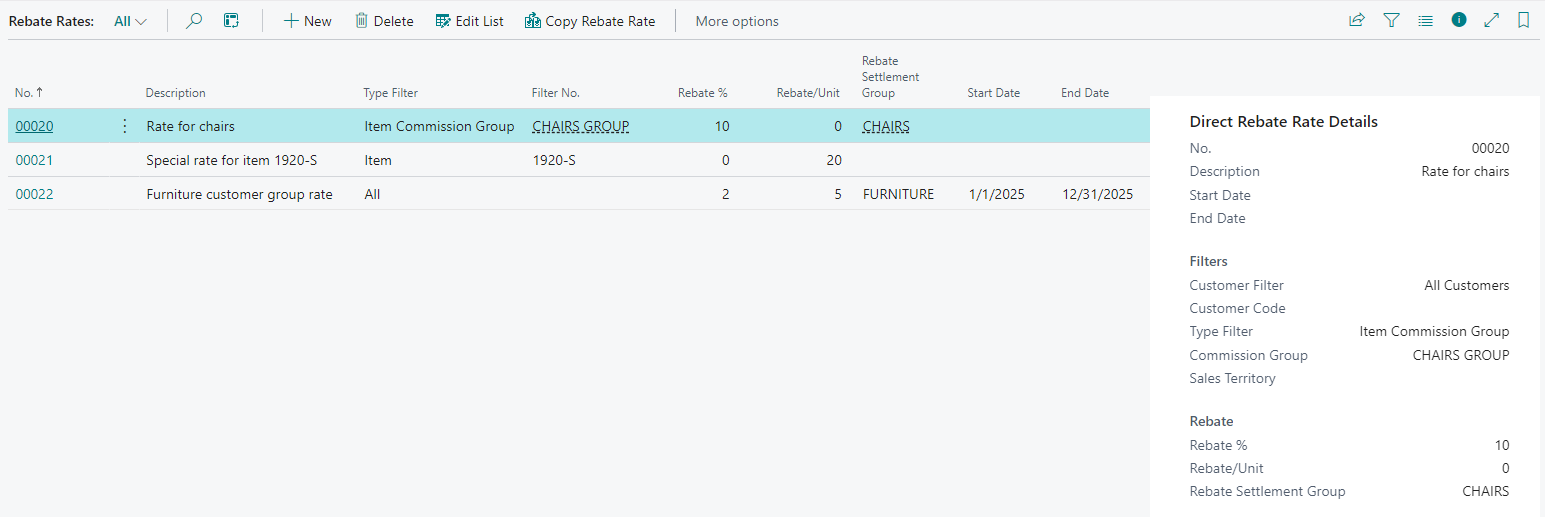
Configuration
To set up a rebate rate, the following fields are available, grouped by their functionality:
General
Optionally, you can set a period of dates on which the rate will apply.
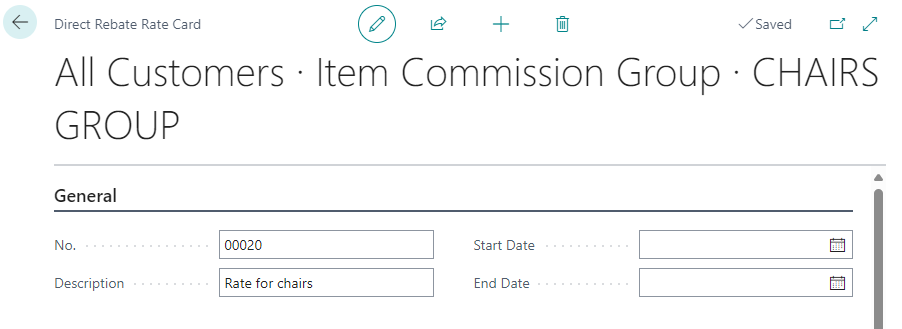
- No. This is the serial number that identifies the rate. It is automatically generated based on the serial number defined in the general setup, but it can be manually edited within the rate.
- Start Date: The date from which the defined rate will be valid. This field can be left blank.
- End Date: The date until which the defined rate will be valid. This field can be left blank. If both dates are blank, the rate will always be active.
- Description: An optional description to facilitate identifying the rate.
- Rebate Group Code: Specifies a rebate group code to which this direct rebate rate belongs. Rebate groups allow you to define and generate additional rebates for sales invoice lines based on each rebate group. Each group can define the following calculation options:
- Priority: Controls the calculation order between rebate groups. Groups with the same priority are calculated in parallel on the same base amount, while higher priority numbers are applied sequentially after previous rebates have been deducted. Priority 1 is calculated first, and the blank rebate group is treated as priority 1.
- Customer Calculation Criteria: Specifies how the customer direct rebate rate is selected within the group. The available criteria select either the highest or the lowest rate found for the customer. If no value is specified, the calculation criteria from the Customer Rebates Setup page is used.
Filters
The rate will apply to sales lines that meet all the filters specified here. Note that dimension and customer filters are hidden by default (use the Show more link located at the top right to show them).
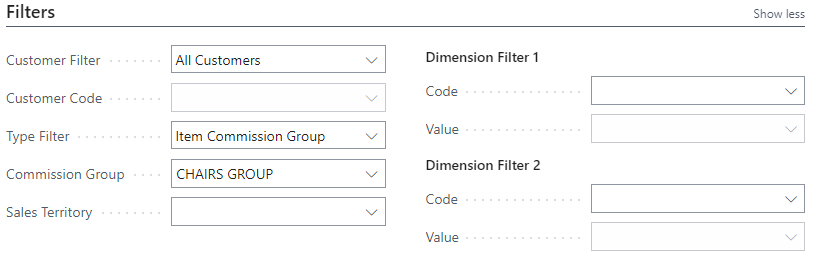
- Customer Filter: The available values are:
- All: The rate applies to all customers.
- Customer Group: The rate applies to a Customer Rebate Group.
- Customer: The rate applies to a specific customer.
- Customer Code / Customer Group: The customer code or rebate group code, depending on the selection in the previous dropdown.
- Type Filter: Defines the type of sales lines to which the rebate rate will apply:
- Item: The rate applies to a specific item.
- Item Category Code. The rate applies to items assigned to this specific item category.
- Resource: The rate applies to a specific resource.
- GL Account: The rate applies to a specific GL account.
- Item Charge: The rate applies to a specific item charge.
- All Items: The rate applies to any sales line of type item.
- All Resources: The rate applies to any sales line of type resource.
- All GL Accounts: The rate applies to any sales line of type GL account.
- All Item Charges: The rate applies to sales lines of type item charge.
- Item Commission Group: Applies to any item assigned to this item commission group.
- Advanced Filter: The rate applies to all elements included in the advanced filter.
- All: The rate applies to all sales lines of type item, resource, or GL account.
- Sales Territory: The rate will only apply to sales documents sold in this sales territory.
- Dimension Filter 1. Specifies a dimension filter. If specified, the rate will only apply to sales lines with this combination of dimension code and dimension value.
- Dimension Filter 2. Specifies an additional dimension filter. If specified, the rate will only apply to sales lines with this combination of dimension code and dimension value.
- Vendor Filter and Vendor Code: These fields restrict the rate to items whose replenishment setup matches the selected vendor criteria. The vendor code is compared with the vendor configured in the item's Replenishment section and applies only to item lines.
Rebate
Details of the rebate that will be generated when the rate applies.

- Rebate %: Indicates the percentage that will be applied to the sales line to calculate the rebate. The line amount is determined after applying the line discount and before applying taxes.
- Rebate/Unit: A fixed rebate amount will be granted for each unit sold. This amount will be added to the rebate amount calculated using the Rebate %.
Additional Conditions
- Maximum Rebate Amount: Specifies the maximum accumulated rebate amount allowed per customer for this rate. If blank or zero, no amount limit is applied.
- Maximum Eligible Quantity: Specifies the maximum accumulated eligible quantity allowed per customer for this rate. If blank or zero, no quantity limit is applied.
Are you interested in multi-currency rebates?
Posting and Billing
The settlement data for the rebate generated from the rebate rate.

Rebate Type: Specifies the type of rebates that will be generated by this direct rebate rate. It can be either customer (you give a rebate to your customer), vendor (you receive a rebate from your vendor every time you sell an item), Vendor-to-customer (both, you receive a rebate from your vendor that you pass on to your customer), related customer (the related customer specified in the customer card) or Return to Vendor (sales returns generate a positive vendor rebate that is settled through a Purchase Credit Memo).
Rebate Settlement Group: Specifies a settlement group code linked to this rebate rate agreement, where you can define the settlement method and custom accounting accounts. If left blank, the system retrieves the information from the general configuration.
Vendor No.: Indicates the vendor linked to the price agreement. This is only considered if the rebate type includes the vendor.
Vendor Rebate Settlement Group: Specifies a vendor settlement group code linked to this rebate rate. If left blank, the system retrieves the information from the general configuration for vendor rebates.
Group by Customer and Rate. Specifies whether direct rebates for this rate will be grouped by customer and rate during generation of customer or vendor rebates.
Return to Vendor
This option supports sales returns posted through sales credit memos when the vendor agrees to support the return. Select Return to Vendor as the rebate type to make the direct rebate entry generated from the return positive. The resulting positive vendor rebate can then be settled through a Purchase Credit Memo.
When Return to Vendor is selected, the following configuration is available:
- Reason Code Filter: Specifies the return reason that posted sales credit memo lines must match for this rate to apply.
- Use Item Vendor: Specifies that the vendor assigned to the generated vendor rebate is taken from the item card instead of the Vendor No. configured for the rate. This supports scenarios where the vendor responsible for the return is defined on the product.
These options allow different return agreements to be configured per rate, including the return reason, the applicable product vendor, and whether the vendor should be taken from the item.
Document Filters
- Minimum Document Amount: Specifies the minimum total amount, excluding tax, that the sales document must reach for this rebate rate to apply. The amount is calculated from all document lines, not only the lines matching this rate. Lines excluded from sales statistics or rebates are not counted, and line or invoice discounts reduce the total.
Entry
Please note that the direct rebate entry is first generated from the configured price agreement. Then, during the grouping and rebate generation process, the associated customer and/or vendor rebates will be created as applicable. Below is a list of direct rebates.

Before generating the first direct rebate entry, ensure that the settlement groups are correctly configured and assigned to the price agreements. Additionally, review the general configuration, as some fields are complementary, and others—such as accrual accounts—may override those in the settlement group if left blank.